
A minute and twenty seconds of beauty

For me, as a photographer, inspiration can come from all sorts of places and will often arrive when I’m least expecting it. I have done a few videos on my YouTube channel looking at where to look for influences and inspiration for street photography and I recently published a video of my Top 10 films to inspire.
As part of the video, I did an honourable mention for a series called Severance, which is obviously not a film but actually a nine-part Apple TV series. I was so taken with the series and found it so enormous inspiring that I just had to include it with my other choices. I’ve watched it three times now and I consider the last episode, episode nine, to be one of the greatest 60 minutes of television that I have ever seen. The levels of tension, drama and excitement are driven to the extreme, as the minutes tick by you are slowly moved ever closer to the edge of your seat. It’s gripping stuff and we are left dangling on the edge of that seat as we await it’s continuation in the next series which will be aired in January 2025.
The title sequence to the programme is also quite something and it’s the perfect lead into each episode with it’s graphic depiction of the world that is Severance. This leads me to another title sequence of particular note that I have found infinitely inspiring, this time, the 1:20 that leads into the TV series Counterpart and it’s a thing of real beauty. The visuals, typography and music all combine to produce one of the most sublime title sequences I have ever seen. I know, I’m gushing again, but just take 1:20 to have a look and see what I mean.
Counterpart, delves into an intricate world of parallel dimensions, doppelgängers, secrets and suspense. In short, a hapless UN employee discovers that the agency he works for is hiding a gateway to a parallel dimension that's in a cold war with our own, and where his ‘other self’ is a top spy. The series is very watchable but, for me, lacks the excitement of Severance. It prides itself on its dark and gloomy atmosphere that one cannot escape from. However, it is very stylish and the intro sequence is one of the few that you don’t want to skip or mute.
Emmy-award winning director and designer, Karin Fong is responsible for creating it.
It’s sort of based around the boardgame Go, and is used as a kind of metaphor. No two Go games are the same and the intro’s theme plays on the nature of identity and how certain choices we make in our lives can change the whole outcome. There is a repeated use of patterns and grids in the images that are used in the sequence, which attempts to symbolise the beaurocracy that Counterpart’s main character, Howard, is trapped in.
I particularly like how the images connect with each other from frame-to-frame, each moving seemlessly into the next. Simple objects relate to the programme’s content. Interwoven with them are graphic scenes featuring two human figures wandering through brutalist style architecture which dominates and isolates them towering over and enveloping with enormous scale. The figures appear trapped and oppressed by their maze-like surroundings with no apparent sign of escape or way out. It’s all beautifully put together and the slow building music that accompanies it adds to the tension and drama that sets up the programme perfectly.
I find visuals like this particularly inspiring when it comes to thinking about street photography. The world that’s conjured up by them is not a million miles from what’s possible to find in our own towns and cities with a little creative thinking. Places like the Barbican Centre in London, with its endless stairways and passages, are wonderful for capturing some dystopian style images.
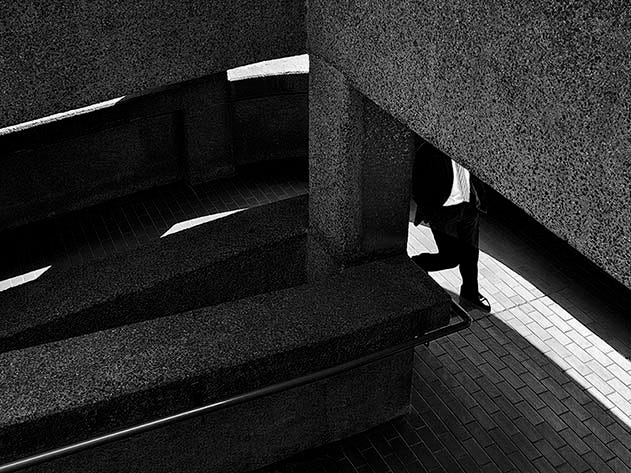
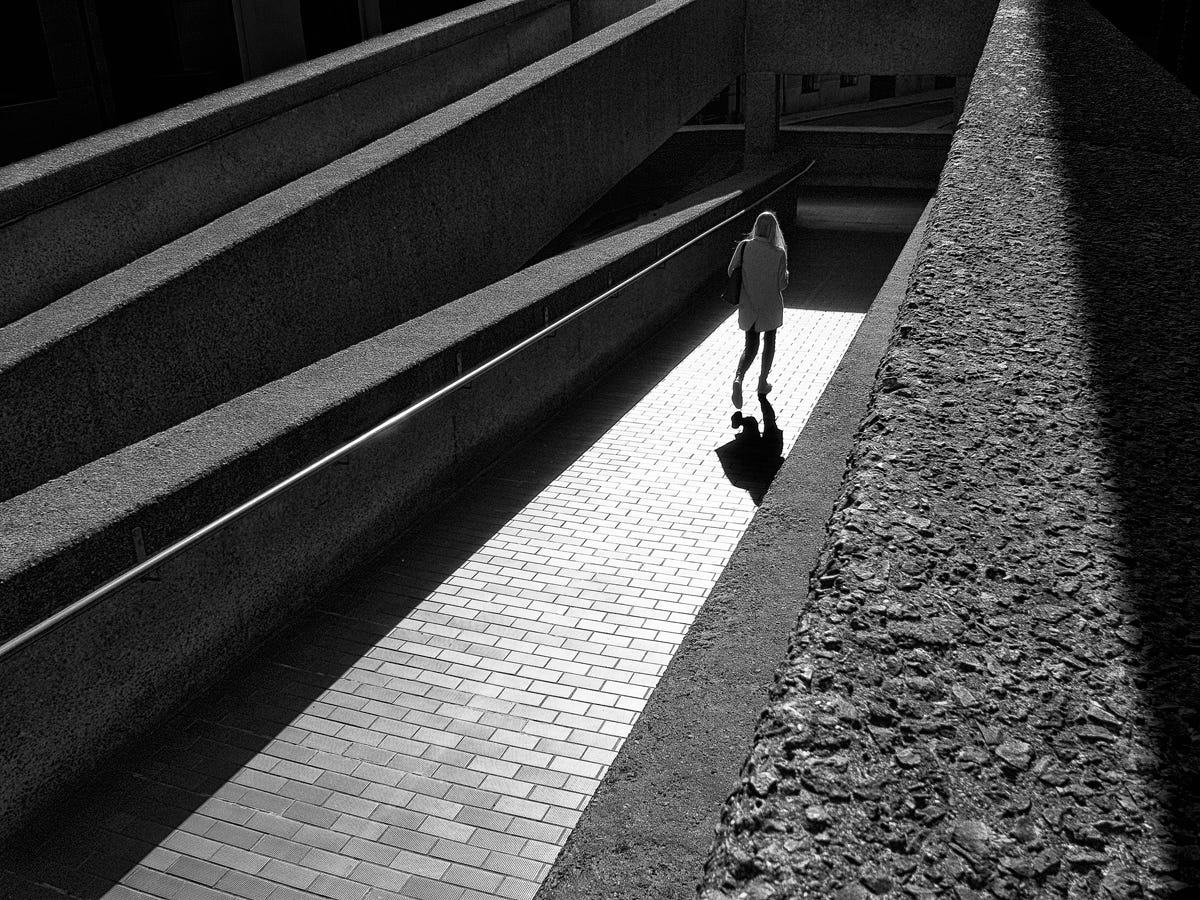
By using a little imagination and thinking about how you can use ordinary looking spaces creatively, such as playing around with viewpoint, scale, light and shade, you can construct images that suggest far more than the ordinary, everyday places that they actually are. Street photography is something to approach with an adventurous and exploring mind and inspiration should come from wherever you can get it. By using the urban environment as a stage, its objects as props and its people as actors, you can create your own striking sequences of imagery.
Thanks for reading!
Please consider subscribing monthly here at Substack or making a one-off
contribution via BuyMeACoffee.
You can also visit my website at rupertvandervell.co.uk where you will find details of
my books and my YouTube channel where I publish videos on all aspects of street photography.
Your support is much appreciated and helps to keep the content flowing!
Catching up on your articles, will certainly have to see if I can access the two series you mention. Go, an intriguing game that I have long wanted to play!😀